

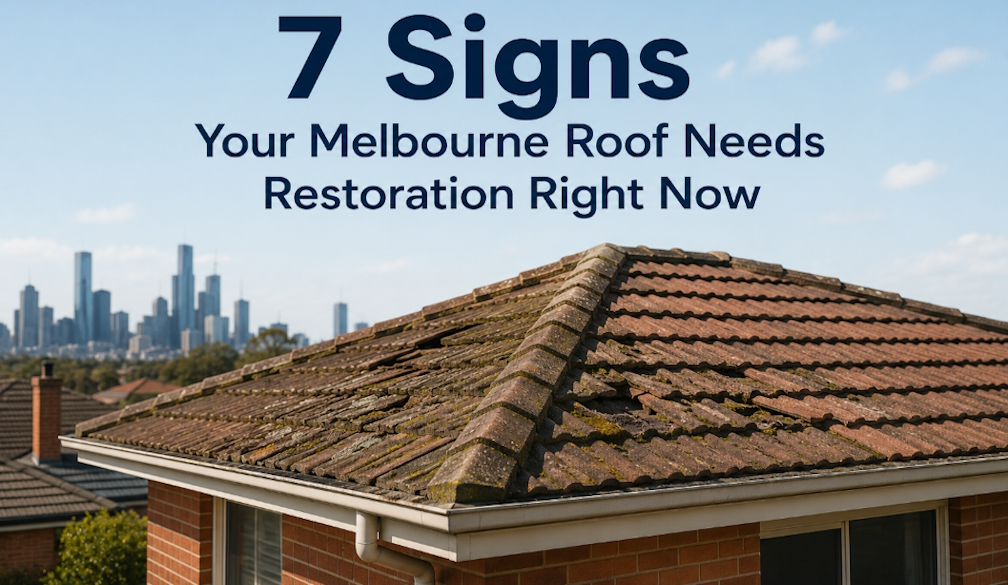
7 Signs Your Melbourne Roof Needs Restoration Right Now
Melbourne weather is genuinely hard on roofs. The combination of scorching summers, cold, wet winters, and those sudden storms that roll in off the bay means that even a well-built roof takes a beating over time. Most homeowners don't think about their roof until something goes wrong inside the house, a water stain on the ceiling, a drip during heavy rain, or a tile that ends up on the lawn after a windy night.
By that point, what could have been a straightforward roof restoration in Melbourne has often turned into something more involved and more expensive. The signs that a roof is struggling tend to show up well before the damage becomes serious, and knowing what to look for is the difference between catching a problem early and dealing with the aftermath of ignoring it.
Here are seven signs that your roof is telling you it needs attention now, not later.
What Are the Most Common and Visible Signs That Your Roof Needs Restoration?
Some of the most common and visible signs include:
1. You Can See Cracked, Broken, or Missing Tiles
Damaged tiles are the most visible sign that something is wrong, and they're also one of the most common reasons homeowners end up needing tile roof restoration in Melbourne. Terracotta and concrete tiles are durable, but they're not indestructible. Years of thermal expansion and contraction, foot traffic from previous maintenance work, and impact from hail or falling branches all take a toll.
A cracked tile might not seem urgent when the weather is dry. But water doesn't need a large gap to get in. Once moisture starts penetrating under damaged tiles, it works its way into the sarking, the battens, and eventually the ceiling space. By the time you notice a stain on your ceiling plaster, the damage underneath has usually been building for a while.
If you're seeing broken or displaced tiles from the ground, or finding fragments in your gutters or on the lawn after a storm, that's not something to put off. Getting roof repairs in Melbourne sorted quickly on damaged tiles prevents a contained problem from spreading into the structure below.
2. Your Roof Colour Has Faded or Gone Patchy
A roof that's lost its colour uniformly might just be aged. A roof with patchy, uneven colouring is telling you something more specific , the protective coating has broken down inconsistently, which typically means water is already sitting on the surface in some areas and the tiles are absorbing moisture they shouldn't be.
On concrete tiles in particular, surface erosion shows up as colour fade and a chalky, powdery texture. Once that protective layer is gone, the tile itself becomes porous and far more vulnerable to moss, lichen, and water ingress. Tile roof restoration in Melbourne at this stage cleaning, resealing, and recoating , gets ahead of the deterioration before it becomes structural.
Faded, patchy colour is the kind of sign that's easy to dismiss because the roof isn't leaking yet. That's exactly why it's worth paying attention to.
3. You've Got Moss, Lichen, or Algae Growing on the Surface
Melbourne's climate , particularly in the cooler, wetter months , is ideal for moss and lichen growth on roofing surfaces. A bit of moss on the ridge might look harmless, but what's happening underneath is anything but.
Moss holds moisture against the tile surface. Over time that moisture works into the tile, and when temperatures drop below freezing in places like the Dandenong Ranges or even on colder Melbourne nights, that trapped water expands and can crack tiles from within. Lichen is even more problematic , it physically bonds to the tile surface and, when it's eventually removed, can take part of the tile with it if it's left too long.
Regular cleaning is part of proper roof maintenance, but if growth has established itself across a significant portion of the roof, that's a sign the surface needs more than a clean. A full roof restoration service that includes treatment, cleaning, and resealing addresses the root cause rather than just removing what's visible.
4. Your Gutters Are Full of Granules or Tile Debris
Your gutters are actually one of the best diagnostic tools for your roof, they collect everything that washes off the surface during rain. If you're cleaning your gutters and finding a significant amount of granules, tile fragments, or sandy sediment, that material has come from your roof and it means the surface is actively eroding.
Granule loss on older concrete tiles indicates the surface coating has broken down past the point where recoating alone restores it properly. It might mean individual tiles need replacing before roof restoration in Melbourne can be carried out effectively.
It's worth getting into the habit of checking what's in your gutters after heavy rain, particularly if your roof is more than 15 to 20 years old. What's sitting in the gutter is a reasonably accurate picture of what's happening on the surface above.
5. There Are Water Stains on Your Ceilings or in the Roof Space
A water stain on your ceiling is the sign most people respond to, and rightly so, because by the time moisture is coming through to the plaster, it has already travelled through multiple layers of your roof structure. What you're seeing on the ceiling is the end point of a leak that's been working its way through for longer than it looks.
If you have roof access, check the underside of the sarking and the battens for moisture, staining, or rot. Water doesn't always travel straight down; it follows the path of least resistance, which means the entry point is often not directly above the stain on the ceiling.
Any active water ingress warrants prompt attention. In severe weather, what starts as a slow leak can become a much bigger problem quickly. Emergency roof repairs in Melbourne are available for situations where water is actively entering the home, but the better outcome is always catching the early signs before it reaches that stage.
6. The Ridge Capping Is Cracked or Separating
Ridge capping, the mortar-bedded tiles that run along the peak of the roof, is one of the first places to show its age, and one of the most important to keep in good condition. The ridge is where the two roof faces meet, and it takes the full force of wind from any direction. If the bedding mortar has cracked, shrunk, or started to separate from the tiles below, it's no longer doing its job of sealing the roof at its highest and most exposed point.
Loose or hollow-sounding ridge caps are a common finding on roofs over 20 years old. They're not always visible from the ground unless they've already shifted significantly, but a loose cap in a storm can come off entirely and either damage the roof surface below or become a hazard at ground level.
Rebedding and repointing ridge capping is a standard part of tile roof restoration in Melbourne and makes a real difference to the structural integrity of the whole roof, not just the ridge line itself.
7. Your Roof Is More Than 15–20 Years Old and Has Never Been Restored
This one isn't about a specific visible symptom , it's about probability. A tile roof in Melbourne that hasn't had any restoration work in 15 to 20 years has been through a significant number of summers, winters, and storms. Even if it's not showing obvious problems right now, the protective coatings will have degraded, the bedding on the ridge capping will have aged, and the likelihood of underlying issues is high.
Roof restoration services at this stage are genuinely preventive , they extend the life of the existing roof significantly and cost a fraction of what full re-roofing would. A restored roof done properly can add another 10 to 15 years of reliable service life. Leaving it until something visibly fails means dealing with the damage that's accumulated in the meantime.
Age isn't a symptom in the same way a cracked tile is, but it's one of the most reliable indicators that your roof is due for a proper professional assessment.
When Should You Call for Emergency Roof Repairs?
There's a difference between a roof that needs restoration work scheduled and a roof that needs immediate attention. Emergency roof repairs in Melbourne are warranted when:
- Water is actively entering the home during or after rain
- Tiles or ridge caps have come off during a storm
- There's visible structural sagging in the roof line
- Debris impact has caused obvious, immediate damage
In these situations, the priority is making the roof weathertight before further water damage occurs. Temporary measures like tarping can protect the interior while permanent repairs are arranged, but they need to happen quickly, leaving a breach in a Melbourne roof during the wetter months means repeated exposure to rainfall while you wait.
For everything short of active damage, a roof restoration in Melbourne that's properly planned and properly executed is almost always the better path than reactive repairs down the track.
What Does Roof Restoration Actually Involve?
A full roof restoration service typically covers:
- Inspection and assessment identifying cracked, broken, or porous tiles, checking ridge capping, gutters, and flashings
- High-pressure cleaning removing moss, lichen, dirt, and loose surface material
- Repairs replacing broken tiles, rebedding and repointing ridge capping, resealing flashings
- Recoating applying protective sealant or membrane coating to restore weatherproofing and appearance
The process addresses the roof as a system rather than treating individual symptoms, which is why a restoration done properly holds up far longer than a series of spot roof repairs in Melbourne carried out over time.
Don't Wait for a Leak to Take Your Roof Seriously
The honest reality is that most roof problems in Melbourne are entirely predictable. The climate here is demanding, roofing materials have finite lifespans, and a roof that isn't maintained will eventually fail. The only variable is whether that failure happens on your timeline , caught early through a restoration ,or on the roof's timeline, usually in the middle of winter during heavy rain.
If you've noticed any of the signs above, or if your roof simply hasn't been looked at in a long time, getting a professional assessment is a straightforward first step. A good assessor will tell you honestly what the roof needs and what it doesn't , whether that's tile roof restoration in Melbourne, targeted roof repairs in Melbourne, or just some maintenance work to keep things in good shape for another few years.
The roof is the one part of your home that protects everything else. It's worth treating it that way.


