

Stainless steel tube in industrial and commercial applications: Material grades, selection, and installation
Few materials have earned the level of trust that stainless steel commands across industrial, food processing, pharmaceutical, and commercial construction applications. Its combination of strength, corrosion resistance, hygienic surface properties, and long service life makes it the default material specification in contexts where failure is not an option, and cleanliness is non-negotiable.
But stainless steel is not a single material; it's a family of alloys with meaningfully different properties, and selecting the right grade, surface finish, and tube specification for the application at hand is more important than most buyers initially appreciate. This guide covers the essentials of stainless steel tubing selection, common applications, and practical installation considerations.
Understanding stainless steel grades
The two grades most commonly specified for industrial and commercial tube applications in Australia are 304 and 316 (and their low-carbon variants, 304L and 316L).
304 stainless steel contains approximately 18% chromium and 8% nickel. It offers excellent corrosion resistance in most environments, is widely available, and is well-suited to food processing, architectural, and general-purpose industrial applications where chloride exposure is limited.
316 stainless steel adds molybdenum (typically 2–3%) to the 304 composition. This addition significantly improves resistance to chloride-induced pitting and crevice corrosion, making 316 the preferred grade for marine environments, pharmaceutical applications, chemical processing, and any setting where salt water or chloride-containing cleaning agents are present.
316L (low carbon) is specified where welding is required; the reduced carbon content minimises sensitisation and the associated risk of intergranular corrosion in the heat-affected zone.
Tube dimensions and tolerances
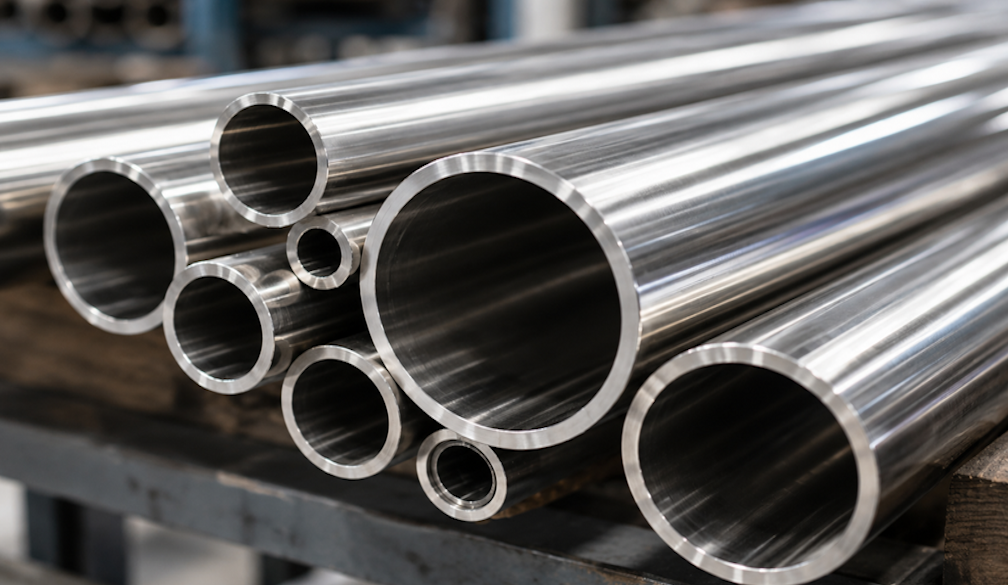
A stainless steel tube is specified by outside diameter (OD) and wall thickness, with the inside diameter (ID) and flow capacity derived from these two values. Tolerances on OD are critical for tube systems that use press fit, compression, or push-fit connections where the fitting design is matched to a specific OD range.
When sourcing stainless steel tube and piping systems for precision applications, confirming dimensional tolerances against the fitting system being used avoids frustrating compatibility issues on site.
Wall thickness is a significant determinant of pressure rating. Thicker walls mean higher pressure capability but also add weight and cost. Matching wall thickness to the actual system pressure requirements with appropriate safety factors is sound engineering practice.
Surface finish and hygiene
In food processing, pharmaceutical, and medical applications, the surface finish of stainless steel tubing is as important as the grade. Surface finish affects cleanability, bacterial adhesion, and visual inspection capability.
Common finishes for hygienic applications include:
- 2B — the standard cold-rolled finish, smooth and suitable for many food and dairy applications
- Electropolished — the smoothest surface achievable, produced by controlled electrochemical removal of surface material; the standard for pharmaceutical and high-purity applications
- Mechanically polished — typically specified by Ra (surface roughness) value in micrometres; common in food and beverage at Ra ≤ 0.8 µm
For general industrial applications where hygienic requirements are less stringent, stainless steel tubing in standard mill or 2B finish is typically appropriate and more cost-effective.
Common applications for stainless steel tubes
The breadth of industries that rely on stainless steel tubes reflects its versatility:
- Food and beverage manufacturing — dairy, brewing, juice production, meat processing
- Pharmaceutical and biotech — process piping, clean steam, water for injection (WFI) systems
- Chemical processing — transfer of aggressive media where carbon steel would corrode
- Compressed air and gas distribution — where cleanliness and corrosion resistance are priorities
- HVAC and building services — hydronic systems, chilled water, heat exchangers
- Marine and coastal construction — where 316 grade provides chloride resistance
- Architectural applications — handrails, balustrades, facades, and structural elements
Jointing and installation methods
Stainless steel tube can be joined by welding (TIG welding for hygienic and precision applications), press fit, compression fittings, or flanged connections, depending on the application requirements and the need for future disassembly.
TIG welding in orbital systems produces the highest-quality, most consistent joints for hygienic applications, smooth internal surfaces with no crevices or dead spots where contamination could accumulate. Press fit provides an efficient alternative for non-hygienic or lower-grade applications where speed and elimination of hot work are priorities.
All stainless steel installations should include provisions for thermal expansion, appropriate support spacing to prevent sagging and vibration fatigue, and isolation from dissimilar metals to prevent galvanic corrosion in wet environments.
Conclusion
Stainless steel tube is one of the most reliable materials available to engineers and project managers across Australian industries. Understanding the difference between grades, dimensions, and surface finishes allows more precise specification and avoids costly mistakes, whether that's over-specifying an expensive pharmaceutical-grade tube for a general compressed air line, or under-specifying 304 in a coastal environment where 316 is the right call.
The right material, matched to the right application, installed correctly, will serve reliably for decades, which is exactly why stainless steel remains the material of choice wherever performance and longevity matter.


