

Housing downturn accelerates as falling values become more widespread
- Written by Corelogic
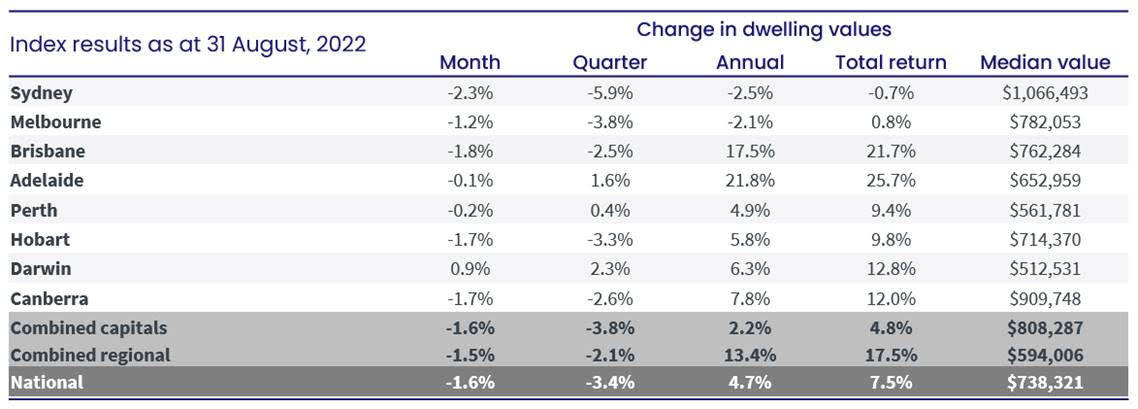
CoreLogic’s national Home Value Index (HVI) recorded a fourth consecutive month of decline in August, with the downturn accelerating and becoming more geographically broad-based. Down -1.6% over the month, the national index recorded the largest month-on-month decline since 1983.
Every capital city apart from Darwin is now in a housing downturn, with a similar scenario playing out across the rest-of-state regions, where only regional South Australia recorded an increase in housing values for the month.
Sydney continued to the lead the downswing, with values falling -2.3% over the month, however weaker conditions in Brisbane accelerated sharply through August, with values falling -1.8%.
CoreLogic’s research director, Tim Lawless, said Brisbane’s shift into decline had been acute after almost two years of sustained growth due to record high internal migration and relative affordability.
“It was only two months ago that the Brisbane housing market peaked after recording a 42.7% boom in values. Over the past two months, the market has reversed sharply with values down -1.8% in August after a -0.8% drop in July,” Mr Lawless said.
After recording significantly stronger appreciation through the upswing, the fall in regional dwelling values is catching up with the capital cities. Regional home values were down -1.5% in August compared with a -1.6% fall in values across the combined capitals. Between March 2020 and January 2022 regional dwelling values surged more than 40% compared with a 25.5% rise for the combined capitals.
“The largest falls in regional home values are emanating from the commutable lifestyle hubs where housing values had surged prior to the recent rate hikes,” Mr Lawless said. “Over the past three months, values are down -8.0% across the Richmond-Tweed, -4.8% across the Southern Highlands-Shoalhaven market and -4.5% across Queensland’s Sunshine Coast.“
Across the 41 regional SA4 sub-regions analysed, only seven areas recorded a rise in housing values in August including the northern suburbs of Adelaide (0.9%), Perth’s North East and Mandurah (0.6% / 0.5%) and the Coffs Harbour-Grafton region (0.6%).
The annual trend in housing values is rapidly levelling out. After moving through a peak annual growth rate of 21.3% in November last year, the annual growth rate across the combined capitals has eased back to just 2.2%. Values across Sydney (-2.5%) and Melbourne (-2.1%) are now below the level recorded this time last year.
Despite the recent weakness, housing values across most regions remain well above pre-COVID levels. Home values in all capital cities and rest-of-state regions, bar Melbourne, remain 15% or above the levels recorded in March 2020, implying most home owners have a significant equity buffer before their home is likely to be worth less than what they paid.
“A 15% peak to trough decline would roughly take CoreLogic’s combined capitals index back to March 2021 levels,” Mr Lawless said. “Additionally, many home owners would have had at least a 10% deposit and paid down a portion of their principal, the risk of widespread negative equity remains low.”
Mr Lawless expects the downturn will continue to play out through the remainder of the year, and possibly into 2023.
“It’s hard to see housing prices stabilising until interest rates find a ceiling and consumer sentiment starts to improve,” he said.
“From current levels, interest rates are likely to increase by at least another 75 basis points and there is a good chance advertised stock levels will accumulate through the spring selling season, providing more choice for buyers and adding further downwards pressure on housing values.”